The Core Role of PLCs in Screw Locking Automation | Industrial Automation Control Technology
Programmable Logic Controllers in Screw Locking Automation
Screw fastening is a critical process in manufacturing, directly impacting product integrity and safety. Manual operations often lead to inconsistencies and defects. Automated screw locking systems resolve this through precision control – and at the heart of these systems lie Programmable Logic Controllers (PLCs). These rugged industrial computers orchestrate every aspect of the fastening sequence, turning complex tasks into repeatable, error-free operations.
PLCs serve as the central nervous system in screw locking automation. They process real-time signals from sensors detecting screw presence, torque levels, and positional alignment. Based on pre-programmed logic, PLCs dynamically adjust servo motors, pneumatic tools, and conveyors. For example, if a torque sensor indicates insufficient tightening force, the PLC immediately triggers corrective actions – such as re-torquing or rejecting faulty assemblies – within milliseconds.
Flexibility is a hallmark of PLC-driven systems. A single controller can manage multiple screw types or product variants on an assembly line. Engineers simply modify ladder logic to change tightening sequences, torque values (e.g., 2.5–50 Nm), or speed parameters without hardware reconfiguration. This adaptability is why PLC automation excels in high-mix production environments like electric vehicle battery assembly, where hundreds of uniquely positioned screws require specific torque profiles.
Key advantages over traditional methods include:
- Error elimination: 99.9% reduction in missed or loose fasteners
- Traceability: Digital logging of torque data for compliance (e.g., ISO 9001)
- Scalability: Modular expansion for additional stations or new product lines
In electronics manufacturing, micro-screw applications demand sub-Newton-meter precision. PLCs achieve this through closed-loop control, modulating current to motors instantaneously. Automotive chassis lines similarly leverage PLCs to coordinate multi-axis robots and inline verification systems. Each fastener undergoes optical inspection and torque validation, with PLCs flagging deviations before progression.
The next evolution integrates PLCs with Industrial Internet of Things (IIoT) architecture. Modern controllers feature Ethernet/IP connectivity, enabling centralized monitoring of screw-locking KPIs across global facilities. Data analytics predict tool wear by tracking increasing torque variance – reducing downtime. Machine learning algorithms further optimize tightening curves based on historical performance data.
As assembly complexity grows, PLC-driven screw locking remains indispensable. By merging deterministic control with smart capabilities, these systems elevate quality standards while cutting operational costs – proving that robust automation foundations are built one screw at a time.
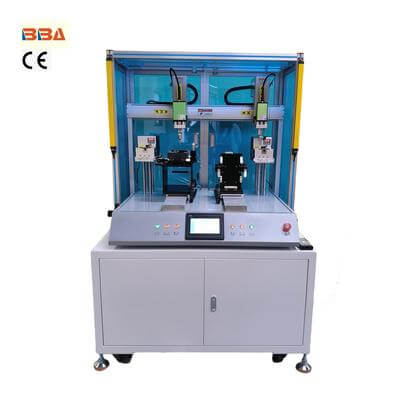
| Product Name | Applicable industries |
| Smart Screw Driving Machine | Industrial Control Panel Assembly |