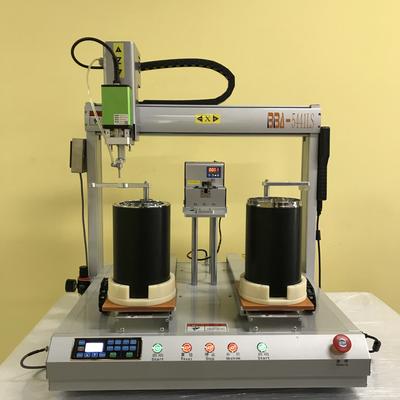
High-Precision Insertion Comparison of Servo and Stepper Motors - Industrial Screw Driving System Selection Guide
Product Name<\/strong><\/td>\n | Applicable industries<\/strong><\/td>\n<\/tr> | Auto Screwdriver Machine<\/td>\n | Consumer Electronics Assembly<\/td>\n<\/tr> | Screw Locking Robot<\/td>\n | Smartphone Manufacturing<\/td>\n<\/tr> | Screw Fastening Unit<\/td>\n | PCB and Circuit Board Assembly<\/td>\n<\/tr> | Servo Screwdriver Robot<\/td>\n | Medical Device Manufacturing<\/td>\n<\/tr> | Automatic Screw Feeder<\/td>\n | Telecommunication Equipment Assembly<\/td>\n<\/tr> | Desktop Screwdriver Robot<\/td>\n | Drone and UAV Manufacturing<\/td>\n<\/tr> | CNC Screw Fastener<\/td>\n | Toy and Game Console Production<\/td>\n<\/tr> | Smart Screw Driving Machine<\/td>\n | Electric Bicycle Assembly<\/td>\n<\/tr> | Dual Head Screwdriver<\/td>\n | Smart Wearables Production<\/td>\n<\/tr> | Inline Screw Locking System<\/td>\n | Security Equipment Manufacturing<\/td>\n<\/tr><\/table> | Servo vs Stepper Motor in Screw Driving Systems<\/b> In screw tightening operations, accuracy and repeatability<\/b> are paramount. Servo motors, equipped with encoders for real-time feedback, typically outperform stepper motors in closed-loop positioning tasks. They can achieve sub-micron precision (<0.001mm) by dynamically adjusting to load variations, ensuring consistent torque and angle alignment even under fluctuating conditions. Stepper motors, on the other hand, operate in open-loop mode by default, relying on step counts and solely mechanical phase locking to maintain position. However, advanced closed-loop stepper systems are emerging, which will introduce feedback mechanisms to reduce error margins. Their resolution can be fine-tuned via microstepping, achieving angular displacements as small as 0.9° per step when properly configured. Despite this, encoderless designs leave open the potential for missing steps, leading to backlash or misalignment at low speeds.<\/p> \n \n When evaluating dynamic performance, speed and torque characteristics<\/b> become key differentiators. Servo motors deliver superior torque-to-inertia ratios across high RPM ranges, which translates to faster feedforward acceleration and deceleration during screw insertion. Their ability to operate in three-phase sinusoidal modes minimizes cogging effects, achieving 5,000 RPM+ speeds while maintaining full torque output. Stepper motors, designed for high pole counts and detent torque, inherently provide better low-speed stability, which is useful for initially threading a screw without cross-tapping. However, torque declines above 3,000 RPM due to the inability to adequately charge windings at higher switching frequencies. This trade-off makes steppers viable for cyclical assemblies with screw pitch diameters below 3mm, while servos suit high-speed multi-axis coordinated work with larger fasteners.<\/p> \n \n Thermal management and longevity are important considerations in operational reliability<\/b>. Servo motors run cooler at steady-state positions because current consumption adjusts to only what's needed through PID controllers. This reduces mechanical wear on gearboxes or lead screws and extends the mean time between maintenance cycles. Steppers, conversely, require continuous full current to hold position, leading to heat buildup over time—especially problematic in 24\/7 environments. Their design also exhibits more resonance at specific frequencies between 100-200 Hz, which may introduce vibration-related inaccuracies unless mechanically damped or electronically compensated..<\/p> \n \n Total system cost analysis reveals contrasting economics. Stepper solutions<\/b> cost 30-50% less upfront because they lack encoders and utilize simpler drive circuits. These systems are ideal for simple joints with 2-speed screwdriving profiles and tolerances exceeding ±0.05mm. Servo motor systems demand higher initial investment due to encoder implementation, high-resolution drives, and tuning requirements. However, this cost can be justified in precision-dependent processes, where modes like torque slew rate control and programmable velocity profiling enable fine adjustments for material variations and prevent common defects like stripped threads.<\/p> \n \n For integration flexibility, control complexity and footprints<\/b> play a major role. Servos require programmable drives with software calibration but allow modular reuse, making them better for machines across multiple product lines. Steppers accept pulse-direction signals directly, eliminating the need for complex tuning, though they have larger physical profiles due to required retainers and step-down reducers. Both benefit from direct coupling over belt drives, but servos show less positional drift during poweroutages when combined with absolute encoders.<\/p> \n \n Neither motor type is universally optimal. Stepper motors gain favor in cost-sensitive, low-complexity screw driving tasks with limited start-stop cycles. Servo motors excel in critical joints found in electronics and aerospace assembly, where programmable torque ramps, stall detection, and energy-efficient open ventilation enclosures are essential. As industrial IoT gains traction, servos' support for real-time diagnostics through fieldbuses like EtherCAT gives them added future-readiness over traditional stepper-based kinematic structures. Understanding these mechanical and electrical parameters empowers designers to select solutions tailored to throughput needs and system longevity.<\/p> |