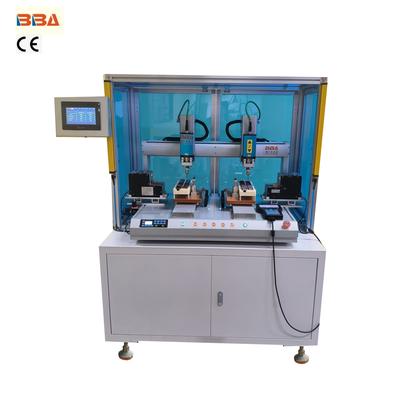
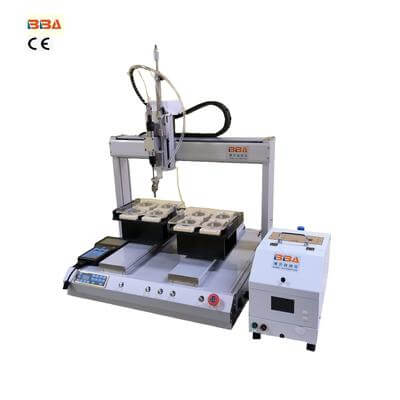
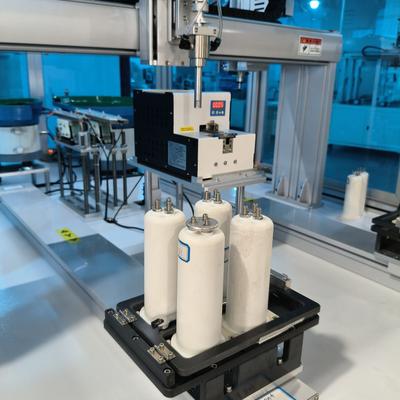
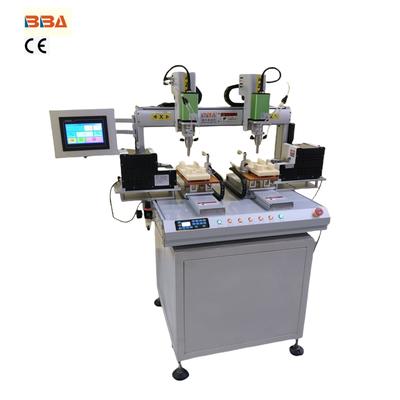
Multi-Axis Robots for Dual-Side Assembly | Industrial Automation
| Product Name | Applicable industries |
| Dual Head Screwdriver | Industrial Control Panel Assembly |
Multi-Axis Robots for Dual-Side Assembly Tasks
The landscape of industrial manufacturing is undergoing a profound transformation, driven by the need for greater precision, efficiency, and flexibility. At the forefront of this evolution are advanced multi-axis robots, specifically engineered to tackle the complexities of dual-side assembly operations. These sophisticated systems are redefining production capabilities, enabling a new era of automated manufacturing.
The Challenge of Dual-Side Assembly
Traditional automation often struggles with components that require processing on multiple sides. Manual intervention or the use of multiple dedicated machines for flipping and re-fixturing parts introduces significant bottlenecks. This leads to increased cycle times, higher risks of product damage, and inconsistent quality. Dual-side assembly tasks, common in industries like electronics, automotive, and consumer goods, demand a solution that can handle these operations seamlessly within a single, unified workflow.
Engineering Excellence: The Multi-Axis Advantage
Modern multi-axis robots are designed to overcome these challenges. With typically six or more axes of movement, these robots mimic the dexterity of a human arm but with far greater repeatability, reach, and payload capacity. This high degree of freedom allows a single robot to access a part from virtually any angle, performing intricate tasks on both the top and bottom surfaces without ever letting go of the component.
Key features that make these robots ideal for dual-side work include:
- Unprecedented Dexterity: The ability to twist, turn, and reach around obstacles to perform tasks on multiple planes.
- Integrated Force Sensing: Allowing for precise contact operations like insertion, polishing, or screw driving on any surface with consistent quality.
- Streamlined Workflow: Eliminating the need for secondary flipping stations or manual processes, significantly reducing cycle time and floor space.
- Enhanced Vision Integration: Advanced vision systems enable the robot to identify part orientation and make micro-adjustments in real-time, ensuring perfect alignment for tasks on both sides.
Transforming Production Lines
The implementation of these robotic systems brings tangible benefits to the factory floor. Production lines become significantly more agile, capable of running mixed products with minimal changeover time. Quality consistency improves dramatically as human error and part handling damage are minimized. Furthermore, these robots excel in environments that may be hazardous or ergonomically challenging for human workers, enhancing overall workplace safety.
From assembling complex circuit boards requiring soldering on both sides to installing interior and exterior components on a automotive sub-assembly, the applications are vast. The flexibility of these systems means they can be quickly reprogrammed and redeployed as product designs change, protecting your investment for the long term.
The Future is Flexible
As products become more complex and consumer demand pushes for greater customization, the role of intelligent, multi-axis robots will only expand. They are no longer just tools for automation but are becoming the central nervous system of the smart factory. The ability to perform dual-side assembly is a critical step towards fully lights-out, flexible manufacturing cells that can operate autonomously and adapt to new tasks with ease.
Investing in this technology is not merely about automating a process; it is about fundamentally re-engineering your production for superior performance, resilience, and future growth.