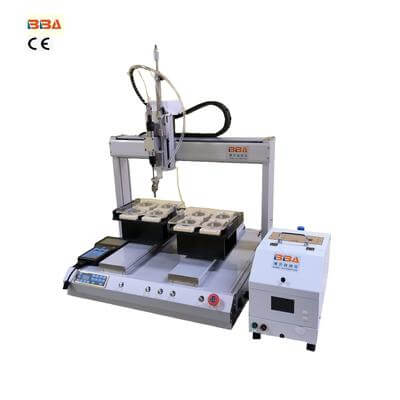
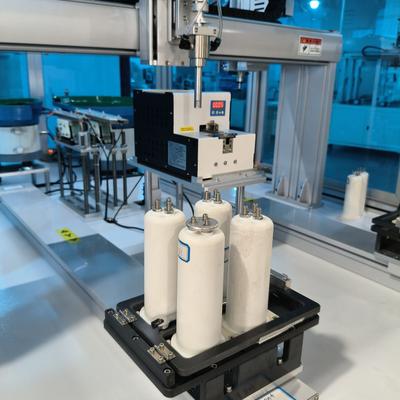
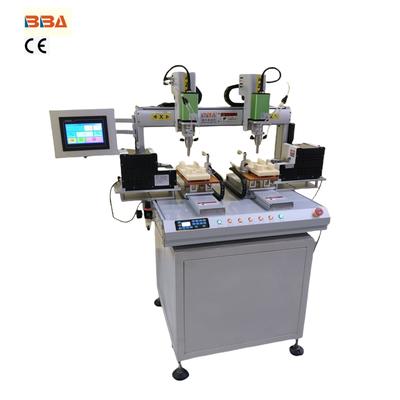
智能可穿戴制造用双头螺丝刀 | 视觉引导精密解决方案
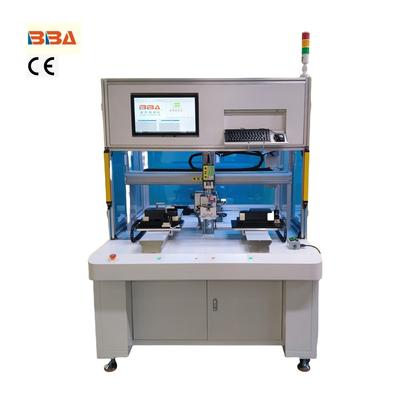
| Product Name | Applicable Industry |
| Dual Head Screwdriver | Smart Wearables Production |
In today’s fast-paced manufacturing landscape, precision and efficiency are non-negotiable. Vision-guided screw locking machines are emerging as a transformative solution, redefining assembly line accuracy while addressing the growing demand for error-free production. Combining advanced optics, artificial intelligence, and robotics, these systems are setting new standards in industrial automation.
The Core Technology Behind Vision-Guided Systems
Modern vision-guided screw locking machines leverage high-resolution cameras and sophisticated algorithms to perform real-time analysis of workpieces. Unlike traditional systems reliant on pre-programmed coordinates, these machines dynamically adjust to variations in part positioning, surface irregularities, or environmental changes. The integration of AI-driven pattern recognition ensures precise screw placement, even in complex assemblies with tight tolerances. This eliminates manual recalibration, reduces downtime, and enhances adaptability across diverse production scenarios.
Applications Across Industries
The versatility of vision-guided screw locking technology makes it indispensable in sectors requiring millimeter-level accuracy. In automotive manufacturing, these systems ensure flawless assembly of delicate electronics and engine components. Electronics producers benefit from their ability to handle miniature screws in smartphone or IoT device production without damaging fragile PCBs. The aerospace industry utilizes them to maintain compliance with rigorous safety standards during aircraft component assembly. Additionally, medical device manufacturers rely on these machines to achieve the sterile precision required for surgical instruments and implantable devices.
Future-Proofing Production Lines
As Industry 4.0 advances, vision-guided screw locking machines are evolving into intelligent nodes within connected factories. Future iterations will feature enhanced predictive maintenance capabilities, using torque and visual data to anticipate wear on screws or tools. Integration with IoT platforms will enable real-time quality tracking, while machine learning algorithms will continuously optimize tightening sequences based on historical performance data. These advancements will further reduce defect rates, cut energy consumption, and support sustainable manufacturing practices.
The shift toward vision-guided automation is more than an upgrade—it’s a strategic investment in manufacturing resilience. By minimizing human error and maximizing throughput, these systems deliver measurable ROI while future-proofing production capabilities. As customization demands grow and product lifecycles shorten, manufacturers adopting this technology today position themselves at the forefront of precision engineering.